


Tourmaline -The Emperor’s Stone
It was the summer of 1777. Empress Catherine II of Russia, celebrating her fifteenth year on the throne, hosted a lavish party. As she appeared for her grand entrance, she brandished an incredible walking stick crowned with a large diamond solitaire and festooned with tassels containing 450 diamonds. Her guests were awestruck.
Catherine’s visiting cousin, King Gustav III of Sweden, was so taken with the object that Catherine gave it to him as a gift. Gustav was in a fix. Protocol dictated that he had to reciprocate with a gift of equal splendor. He had just the item in mind. A mysterious 255-carat ruby-red jewel with a murky past.
The first mention of the jewel appeared in the 16th century, catalogued in the possessions of King Charles IX of France. Upon his death, his wife Elisabeth carried the impressive red stone to her father’s court in Austria. When her brother, Emperor Rudolph II ascended to Austria’s throne, early gemmologist Boetius de Boot, described the stone among his collection as a unique gem and referred to it as ‘Caesaris rubinus,’ or the Emperor’s Ruby. The stone has since been known as the legendary Caesar’s Ruby, even though, in truth, it is an extraordinary rubellite tourmaline, shaped like a cluster of grapes and set with green-enameled gold leaves.
During Europe’s 30 Year War in the 17th century, the Swedish Army captured Prague Castle, looting its treasure and carrying home the coveted gem. The stone was prized, pawned, and regained before ultimately arriving as a gift fit for Catherine the Great. Caesar’s Ruby remains in the Kremlin proudly displayed with the other Russian Crown Jewels. In 1922, minerologist Aleksandr Fersman oversaw an inventory of the collection. It was then that enigmatic gem was revealed to be a tourmaline, not a ruby at all.
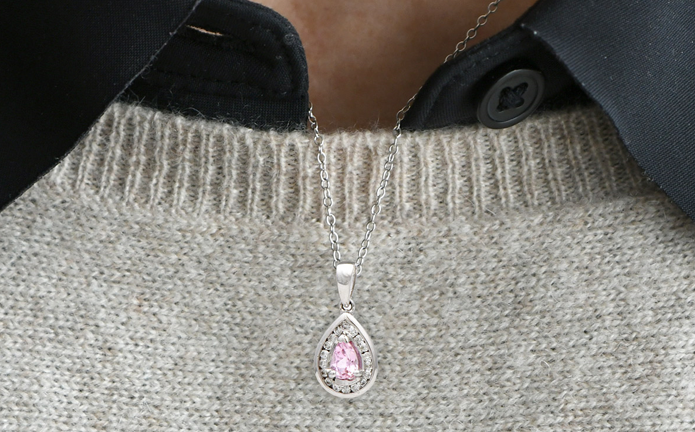
Tourmaline gemstones come in such a wide array of colors they’ve often been mistaken for other stones, including emeralds and rubies. In fact, the name is likely derived from the Sinhalese “Tourmali” which means mixed-color gem. The most common color is pink, but it can be found in such extraordinary varieties as black or Schorl, cat’s eye, and even watermelon. The oldest known carved tourmaline is a stunning multicolored intaglio depicting Alexander the Great and is believed to date to the era of his reign, roughly 330 BCE. The largest carved tourmaline, is a 376-carat emblem of a woman in profile.
Tourmaline has been mined in many places all over the world, but in the late 1800s, a large deposit was discovered in California. At the time, the biggest market for the stones was China, where Dowager Empress Tz’u Hsi adored the color. When the Chinese government collapsed in 1912, so did the American Tourmaline trade. Finds of intense new shades and colors of tourmaline, from neon green to electric blue, surfaced later in Brazil, rekindling interest in the stone. Since then, other mines for the gem have opened in places from Madagascar to Afghanistan.
Tourmaline lore attributes the power of healing to the many-colored stones. Many believe the gem can cure depression, strengthen body and spirit, and bring peace to the soul and to relationships. Native Americans gave certain colors of tourmaline as funeral mementos. Many of the Chinese tourmaline acquisitions were carved into snuff bottles or set into jewelry. Today, tourmaline is popular both as a cut stone in a setting and a shaped bead for bracelets.
This October birthstone is a versatile, dazzling, rainbow of possibilities. Prized by empresses, treasured as a balm for the spirit, and tinged with mystery, these gems are singularly remarkable. Explore our tourmaline inventory here.



