


Topaz – Stone of Many Colors
Legend holds that in the 1100s, Lady Hildegarde, wife of a Dutch count, donated a large golden topaz to a monastery. The stone was said to illuminate the chapel. The topaz glowed so brightly, the entire congregation could read their prayers without candlelight or lamps.
Europeans were not the first to marvel at the luminiosity of topaz gems. Ancient Egyptians believed the golden color was bestowed upon the topaz by the sun god Ra. One possible origin of the stone’s name might be the Sanskrit word ‘tapaz’ which means ‘fire.’ Another potential source of the name comes from the island of Topazios, once the source of the ancient world’s peridot gems, which are often confused with topaz.
Topaz gems have inspired centuries of folklore. First discovered almost 3,000 years ago, they’ve been symbols of love and talismans against harm for many cultures. Romans used topaz to defeat poisons, while Indians wear topaz over the heart to enhance beauty and intelligence. Topaz is believed to be one of the twelve gemstones described on the Biblical breastplate of Aaron.
One of topaz’s defining qualities is its wide variety of colors, both natural and irradiated. While it’s most commonly associated with yellowish or golden hues, here are just a few of the other types available:
Imperial: One of the rarest varieties, this type can be yellow to orange and red. Many of these gems are found in the Ural Mountains, and the name reflects its deep connection with Russian royalty, who used it to create incredible jewelry.
Sherry: This yellow brown shade is named for sherry wine.
Galileia: This soft, peachy pink is created using a patented technique.
Brown: Often confused with smoky quartz, brown topaz is less popular than more vibrant varieties.
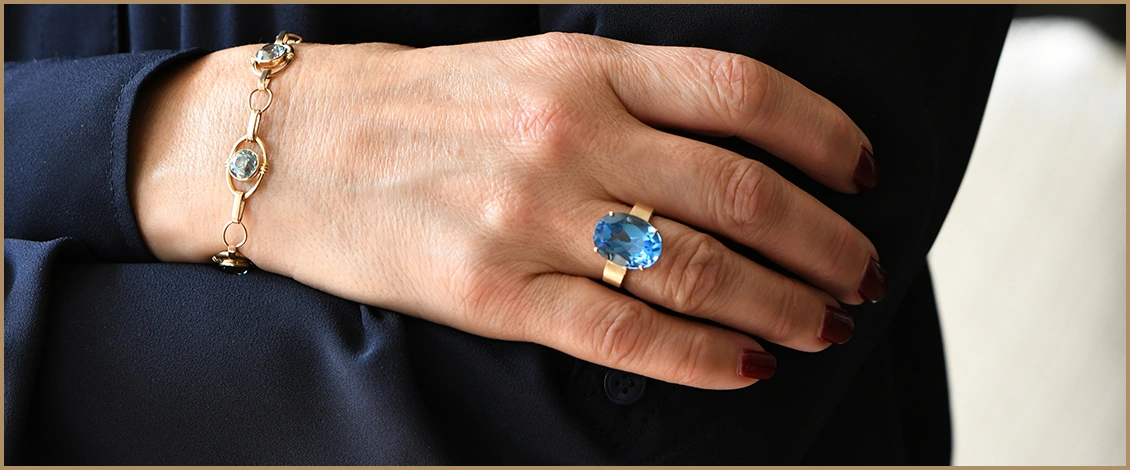
Blue: Recently, blue topaz has become the favored hue. Natural blue topaz is usually quite pale, but heat treating either colorless or light blue topaz creates the vibrant blue stones that are popular today.
A second outstanding attribute of topaz is its hardness. The stone rates an impressive 8 on the Mohs scale, making it tough and durable for daily wear. Heat and light can discolor topaz, and because of its hardness, it can scratch softer stones if not stored carefully.
The largest topaz ever found was believed to be a whopping 1,680 carats and remains shrouded in mystery. Discovered in Brazil in the 1790s, the gem was immediately carried across the sea to Lisbon, Portugal, to the royal Portuguese house of Braganza. Christened the ‘Braganza Diamond,’ the impressive stone was described as colorless or pale yellow. Several testaments exist describing the rough stone hanging around the neck of Portuguese King John VI. After his death, the stone mysteriously disappeared. Later discoveries of large topaz deposits in that region of Brazil have led scholars to believe that, in truth, the large, pale stone was actually a topaz. Whether the stone now resides with the Portuguese crown jewels or is lost to time is still unknown.
Whether you have a passion for+ these incredible vivid gems or you’re curious to explore the amazing variety of topaz possibilities, you can explore our collection here.



